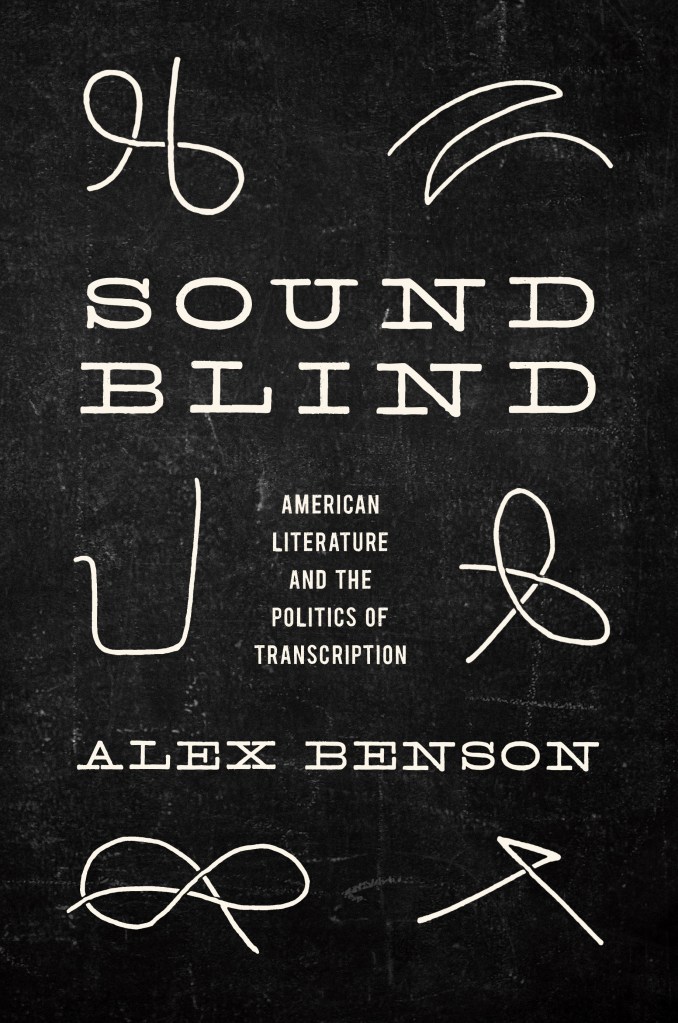
Specializing in 19th and 20th century U.S. literary history, my work addresses questions of language politics, the history of the social sciences, political ecology, and old media. I’m interested in granular stories of text-making — of how and why things get written, revised, published, circulated — and in what those stories can teach us about the situated experience of the cultural and environmental past.
In my first book, Sound-Blind: American Literature and the Politics of Transcription (UNC Press, 2023), the problem of how to accurately transcribe spoken language — a problem of great interest to a wide range of writers and scientists in the late 19th and early 20th century U.S. — offers a way into larger questions about the intersections of colonial power and literary form, of media and ability, and of racialization and land. Traveling across different archives of U.S. print culture (including fiction, anthropology, and the daily press), each chapter orbits around a given detail of textual history. A picture of a cattle brand in an Indian Territory short story, a facsimile of Helen Keller’s autograph, a “tatoo” in F. Scott Fitzgerald’s handwriting. Reading such details as they interface with history at multiple scales, Sound-Blind practices a literary sound studies that is invested in the site — and the limitations — of the graphic archive.
Other recent publications (click each title for a link or PDF) include:
- “The Machine in the Muck” (ISLE: Interdisciplinary Studies in Literature and Environment, 2026), an article on “The Happy Failure,” Herman Melville’s 1854 short story about a nonfunctional marsh-draining device;
- my editorial introduction to John M. Oskison’s “Laboratory Fancy,” an 1897 short story about a talking amoeba (I found this text in archival work for Sound-Blind, and my transcription and introduction were published in January 2022 in the Little-Known Documents section of PMLA);
- “Rat-Fall,” an essay also on Oskison (and on zoology in the Colorado River delta), which appeared as a chapter in the edited volume Contesting Extinctions: Decolonial and Regenerative Futures (Lexington Books, 2021);
- “Gossypoglossia,” a 2019 essay on the language politics of W. E. B. Du Bois’s fictional dialogue, published as part of a special issue of Narrative edited by William Cohen and Laura Green;
- and “‘Bartleby’ on Speed,” a 2019 essay in Leviathan that thinks about how Melville thinks about the social velocities of labor, including the labor of proofreading.
Other essays and reviews have appeared in Small Axe, Criticism, Qui Parle, Syndicate, and American Literary History Online Review.
Moving ahead, one major area of focus in my work (the topic of a book project connected with a couple of the above publications) has to do with the temporalities of extinction discourse.
 ALEX BENSON